
What does Shūyō mean?
November 5, 2026
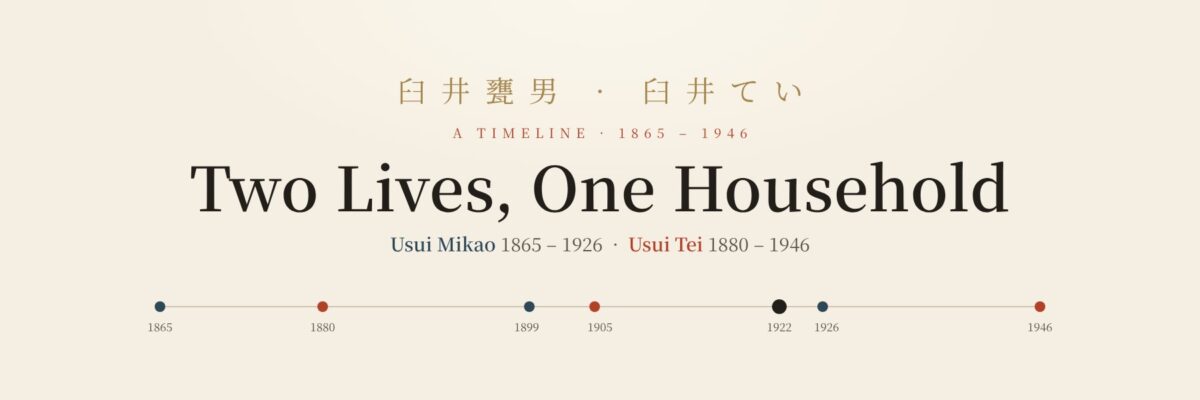
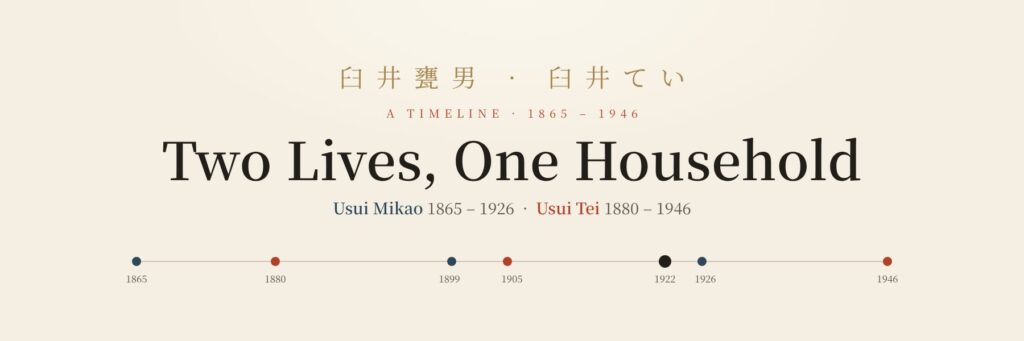
Two Lives, One Household: A Timeline of Usui Mikao and Usui Tei
November 5, 2026
New Research · Usui Sensei’s Family
Usui Tei
The Woman beside Usui Sensei
Personnel files from the Taiwan archives give us, for the first time, a picture of Usui Mikao’s wife: her education, her career, her illness in 1921, and the life she lived after him.
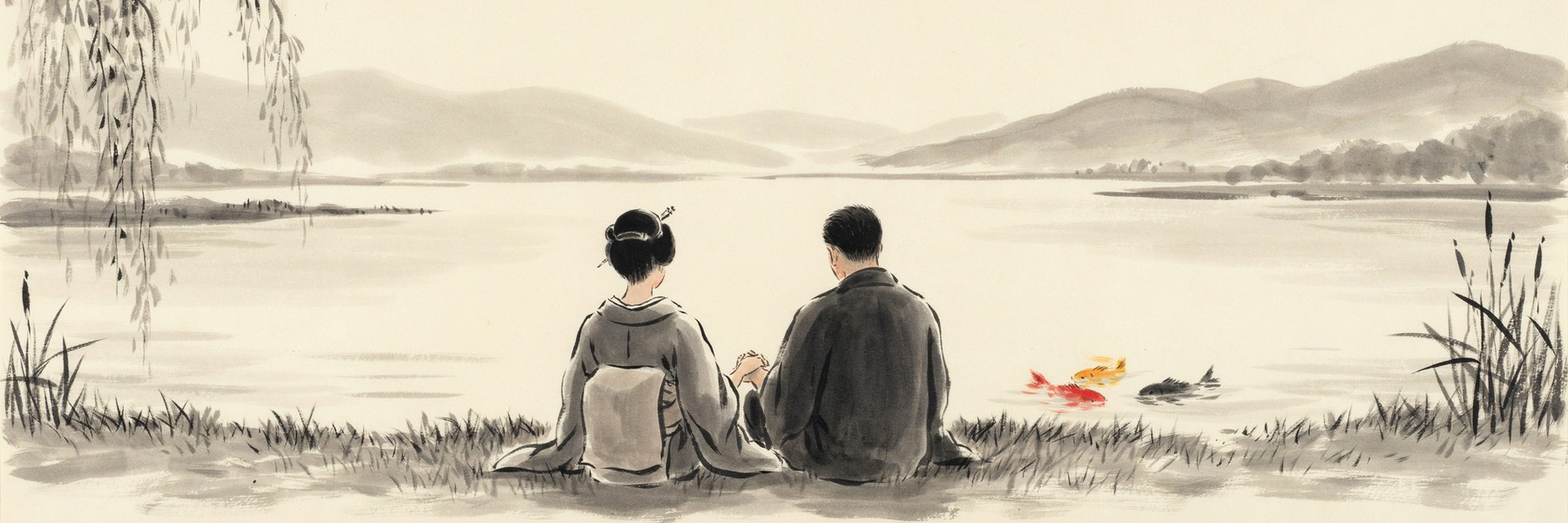
For most of us who practise the system of Reiki from a Japanese perspective, the life of Usui Mikao’s wife was quite unknown. We knew she came from the Suzuki family, that she was called Sadako, and that she died in October 1946. That was all.
That has now changed. Since the discovery of Usui Sensei’s own handwritten CV in the Taiwan archives in 2025 (by Min Wang, with Umi Chien and Yu Hsuan, and written up by Justin Stein; I covered it in The Life of Mikao Usui: A Visual Guide to New Historical Discoveries), researchers have been looking more closely at the records of the Japanese colonial administration in Taiwan. That CV was written in August 1904, when Usui Sensei was hired, shortly before his 39th birthday, onto the committee studying traditional Taiwanese customs under Gotō Shinpei. Olaf has now found a second set of personnel files in the same archive, belonging to a teacher named Usui Tei (臼井てい). With the permission of Taiwan Historica (國史館臺灣文獻館), he has shared what they reveal.
The files cover the years 1905 to 1922 and include two CVs, a handwritten letter of resignation and a medical certificate. Together they give us, for the first time, a picture of a woman with her own education, her own career and her own story.
Tei, Teiko or Sadako?
Usui Sensei’s wife has commonly been known, until now, as Sadako. That reading comes from the memorial stone at Saihōji (西方寺) in Tokyo, erected in 1927, where her name is carved as 貞子.
Both names use the same kanji. 貞 can be read Sada or Tei, so 貞子 can be read Sadako or Teiko. Without a reading guide, Sadako, the more familiar women’s name, became the accepted one. Yet the family grave at the same temple has always written her name as 貞 with the reading aid てい beside it. The reading aid clearly says Tei. That reading was simply overlooked. The Taiwan files now confirm it: across seventeen years of official records, her name is written consistently as Tei (てい).
The 子 (ko) on the memorial stone reflects a formal convention of the period: in official or honorific texts, a ko was often added to short women’s names. So the stone most likely means Teiko, a formal version of Tei, rather than Sadako. From here on I will call her Tei.
Who was Suzuki Tei?
Suzuki Tei was born on 13 January 1880 in Inba District (印旛郡), Chiba Prefecture. After elementary school she was privately tutored in Japanese, classical Chinese and mathematics. In March 1899 she graduated from Aoyama Jogakuin (青山女學院) in Tokyo, the girls’ school run by the Methodist Women’s Foreign Missionary Society.
That detail matters. Usui Sensei’s 1904 CV records that from 1899 to 1903 he was commissioned by an American ladies’ missionary society, almost certainly this same Methodist Women’s Foreign Missionary Society, to set up and supervise a charity school and elementary school in Fukagawa, Tokyo: the Kion (喜音) school. Tei went on to teach at Aoyama Jogakuin, earned her state teaching licence for sewing in March 1900, and from July 1900 to July 1901 was head teacher at a private training school for sewing teachers in Fukagawa (深川), the very district where the Kion school stood. Positions in Nara Prefecture and, from September 1902, at Sennan (泉南) Girls’ High School near Osaka followed.
In April 1905 she signed a CV as “Usui Tei”, giving “Suzuki Tei” as her former name. On 3 May 1905 she was appointed assistant professor and teacher at the Japanese Language School (國語學校 Kokugo Gakkō) of the Government-General in Taipei, nine months after Usui Sensei had taken up his own post there. She later taught at the government middle school and, from 1909, at the newly founded girls’ high school. Between 1912 and 1917 she was appointed four times to the examination committee for elementary school teachers.
Her son Fuji (不二) was born in 1908 and her daughter Toshiko (敏子) in 1914, both during her years of service and so very probably in Taiwan. In all, she worked there for sixteen years, a remarkable career for a Japanese woman of her generation.
Is this really Usui Sensei’s wife?
None of the documents names her husband, so Olaf is careful to present this as a very likely identification rather than a proven one. The pieces that fit together are these:
- Her given name Tei and her maiden name Suzuki match both the family grave and the memorial stone.
- In 1905 she gave her family register as Fukagawa, Nishimoto-machi (西元町) No. 1, the same address Usui Sensei listed in his 1904 CV.
- Both were in the service of the Government-General of Taiwan at the same time.
- In April 1922 she was living in Harajuku (原宿). According to the memorial stone, that is exactly where, and exactly when, Usui Sensei settled and founded the Usui Reiki Ryōhō Gakkai.
Final proof would be an entry in the family register (koseki), but in Japan only family members can access those old records. Short of that, the evidence is strong.
Illness and retirement in 1921
This is where the story becomes especially moving for Reiki practitioners.
From around 1918, Tei suffered from headaches, dizziness, insomnia and failing memory. In early 1921 came weakness, numbness and swelling in her legs. In mid-April 1921 she left Taiwan on medical advice to recuperate in Tennōji (天王寺) near Osaka. There, on 1 May 1921, a Dr Umemura (梅村) issued a medical certificate. His diagnosis was neurasthenia and beriberi (神經衰弱兼脚氣 shinkei suijaku ken kakke), brought on by physical and mental exhaustion.
Beriberi, kakke in Japanese, was one of the most common illnesses in Japan at the time. We now know it is caused by a lack of vitamin B1, and it was especially common among city dwellers and civil servants who lived largely on polished white rice. Weakness and numbness in the legs, swelling and heart trouble are the classic symptoms, and they match Tei’s case closely. In the 1920s the cause was not yet widely accepted, and doctors often prescribed rest and a change of surroundings.
One line in the certificate stands out. Under treatment, the doctor wrote: 精神療法ノ他鎮靜劑强壯劑等ヲ與ヘ, which can be rendered as “besides seishin ryōhō, I gave sedatives and tonics.” Alongside the medication, the physician explicitly relied on seishin ryōhō (精神療法), treatment through the mind or spirit.
The certificate does not say what he meant by it. In those years the term covered everything from doctors’ psychotherapy to the many popular healing methods flourishing in Japan, including suggestion and the laying on of hands. But the fact remains that a physician treating Usui Sensei’s wife in spring 1921, one year before the founding of the Gakkai, turned openly to this approach. He expected her recovery to take several months and considered a relapse likely.
Tei enclosed the certificate with her letter of resignation of 5 May 1921, and on 24 May 1921 she retired from service at her own request. The governor of Taipei Prefecture attested that she had worked with great diligence for more than sixteen years. She received a bonus of 650 yen and was granted a pension of her own.
The year 1921
Put together, 1921 must have been a hard year for Usui Sensei. His wife was seriously ill and could no longer work. And on 15 December 1921, Okamatsu Santarō (岡松参太郎) died, the legal scholar under whom Usui Sensei had worked in Taiwan. As Justin Stein reported earlier this year, Okamatsu was the son of Usui Sensei’s former teacher, and in 1908 the two men shared a house in Taipei. Their connection lasted many years, in Taiwan and later in Tokyo at the South Manchuria Railway.
A few months later, in the spring of 1922, came the events every Reiki practitioner knows: the fast on Mount Kurama (鞍馬) and the founding of the Usui Reiki Ryōhō Gakkai.
What might this mean?
The memorial stone tells us that after his experience on Kurama, Usui Sensei first tried the method on himself and then on the members of his household (家人 kajin), with immediate effect, and that he then decided not to keep it within his own family but to share it widely. The stone never says whom he treated. Knowing that his household at that time included a seriously ill wife gives that sentence new weight.
Perhaps Usui Sensei came to know seishin ryōhō more closely through his wife’s treatment. Perhaps watching a doctor, faced with an illness that medicine could do little about, turn to the powers of mind and spirit was one of the impulses that led him, a year later, to his own healing method. It cannot be proven: neither the certificate nor the memorial stone makes that link. But the timing is striking, and Usui Sensei was no stranger to the subject. His 1904 CV tells us he studied psychology under Motora Yūjirō in Tokyo in 1893, and psychology and philosophy again in America in 1895 and 1896.
Olaf adds that in the Kōkai Denju Setsumeisho (公開傳授說明書), the explanation of the public teachings first published in September 1922, Usui Sensei describes the origin of his method without reference to his family. Here, respectfully, I would disagree. Family is explicitly mentioned, and right at the start. Usui Sensei opens the text by saying that from ancient times, whoever discovered a secret method would pass it on only within the family, as a legacy for later generations, and that he regards this as a bad custom of the past century. He states plainly that he will not allow his family to keep the method to themselves, and that he is opening it to everyone for the benefit and welfare of all. (I have written more about this passage in The Samurai Origins of Reiki.)
Read on its own, that passage has always sounded like a statement of principle. Read with Tei’s medical certificate beside it, it sounds more personal. In the spring of 1922 the “family” Usui Sensei chose not to keep the method for was a household with a seriously ill wife and two young children, and the memorial stone tells us that his family were the first people he treated after himself.
The choice to share rather than keep was made with them in the room.
What the files let us glimpse
We do not know when the two first met. Usui Sensei was already using the name Suzuki by December 1896, when a notice in the official gazette (官報 Kanpō) referred to him by it while he was in America. Tei was sixteen then, Usui Sensei thirty-one. Yet they could hardly have met by then. From 1895 to 1898 Usui Sensei was in America, while Tei was still a schoolgirl being tutored in Chiba and then studying in Tokyo. So the name Suzuki most likely has another origin, perhaps simply a coincidence of one of Japan’s most common surnames.
The first time both can be placed in the same place is 1899 to 1901. Usui Sensei returned from America and began running the Kion school in Fukagawa in 1899; Tei graduated from Aoyama Jogakuin that March, stayed in Tokyo for further training, and from July 1900 to July 1901 taught at a sewing teachers’ school in Fukagawa itself, both within the same Methodist mission. That makes 1899 to 1902 the likeliest window for their meeting. Their marriage most probably followed between 1903 and early 1905: in August 1903 Tei was back in Tokyo for a summer course, and by April 1905 she was signing as Usui Tei, registered at his Fukagawa address.
In Taipei the files give two different addresses: in 1904 Usui Sensei lived near the city’s East Gate, while in 1905 Tei gave an address near the West Gate. Housing for Japanese officials in Taipei was scarce and often tied to one’s post, so it is quite possible the couple lived apart at times.
And one question lingers: where was Usui Sensei in 1921, while his wife was recuperating in Osaka? The files are silent on this, and for now it remains an open question.
A woman who outlived them all
For me, the most important thing this research shows is that behind the familiar portrait of Usui Sensei stood a woman with her own education, her own profession and her own path.
Her later life was marked by loss. In March 1926 her husband died, leaving her with seventeen-year-old Fuji and eleven-year-old Toshiko. Unlike many widows of her time, she at least had some independence through her own pension. In 1935 her daughter Toshiko died at only 21. On 10 July 1946, in the turmoil after the war, she lost her son Fuji as well. Tei outlived her husband by twenty years and both her children. Just over three months after Fuji, on 17 October 1946, she died herself.
Their Posthumous Buddhist Names
Teishin’in On’yo Jōnin Daishi · Reizan-in Shūyo Tenshin Koji
On the family grave at Saihōji, Usui Tei bears the Buddhist name 貞心院温譽浄忍大姉. A posthumous name (kaimyō) is given by the temple and is built in parts:
貞心院 Teishin’in, “Hall of the Steadfast Heart.” The 院 (in) title is an honour, and 貞 (tei) takes up her own given name.
温譽 On’yo, “Warm Honour.” The 譽 (yo) marks a name given in the Jōdo (Pure Land) school, to which Saihōji belongs.
浄忍 Jōnin, “Pure Patience.” This is the heart of the name. 忍 (nin) is patience or forbearance, one of the Buddhist perfections.
大姉 Daishi, “Great Elder Sister,” the honorific for a laywoman.
Usui Sensei’s own posthumous name, on the same grave, carries the same 譽: 霊山院秀譽天心居士 Reizan-in Shūyo Tenshin Koji, “Layman of the Heavenly Heart and Excellent Honour, of the Hall of the Sacred Mountain.” Hers speaks of a steadfast heart, his of a heavenly one.
Both are Jōdo-shū (Pure Land) names, given at the family grave at Saihōji, which has been a Jōdo-shū temple since the early 1600s. It is something they share.
Read together: Great Sister of Pure Patience and Warm Honour, of the Hall of the Steadfast Heart. After everything we now know about her life, it is a fitting name.