

Reiki Waka (Japanese Poems): Sincerity
April 24, 2026
A Hidden Map Inside the Word Reiki
May 3, 2026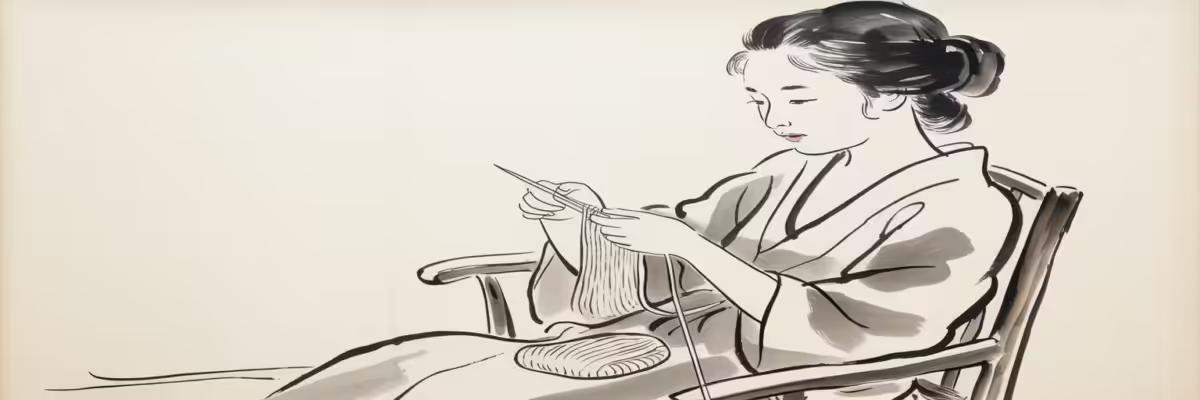
I was teaching recently and found myself saying spark of life where I might once have said breath, where another teacher might say speech. I could see that the word, in this framing, made sense to the student in front of me. And I thought, that’s it. That’s why we do this. (Warning: I’m going to try out some unwieldy knitting analogies in this blog) We find the word that makes the jumper* pattern you are knitting make sense.
But it also made me wonder. When I change a word, am I changing the jumper irretrievably? Umm, I mean, the teaching?
It’s a question every Reiki teacher bumps into eventually. Usually in the middle of explaining something, when the words we utter are slightly misshapen for a moment. So we try out something else. And then later we wonder if we’ve crossed a line.
I might say openness where another teacher says emptiness. I might describe body, mind and breath where a more traditional framing is body, mind and speech or even body, mind and soul. None of us are wrong. We are all knitting rows in the same jumper.
The analogy changes. The meaning doesn’t.
What we sometimes confuse is the difference between how we communicate something and what we are communicating. My spark of life is not a new teaching. It is a jumper that I think might fit you (and me) better. And it’s what good teaching actually looks like, a living responsiveness to the person in front of you, rather than a recitation of received words.
But I don’t want to knit around the real question. (Uuggghh, too much?)
There is something that holds the system of Reiki together across time and across teachers. It’s not just the written lineage, that chain of names traced back to Mikao Usui. What holds it together is something less visible: a fidelity to the heart of the teachings. The five elements. Or even more concisely, the precepts, and their practices. Ultimately, the intent behind the practices.
Lineage, in its deepest sense, isn’t passed down through paperwork. It lives in the moment when something real is transmitted between teacher and student. It lives in how deeply we practice, and how honestly we sit with the precepts, and how much we allow this system to return us.
From that place, the unique expression of the teachings isn’t a departure from the lineage. It is the lineage speaking through you.
So how do I hold this as a teacher?
I stay close to my own practice. This, more than anything, is what maintains lineage.
I also try to know the difference between the bones and the voice. The bones are the core elements of the system, the pattern, the needles, the wool. The voice is how I explain them, the language I use, the way I illuminate something for a student standing in front of me right now, how I make the pattern mine (holes and all). The voice can, and should, be mine.
And when I add something of my own, I say so. This is my way of understanding this, not a received teaching. That distinction is a form of integrity. It gives students clarity about what belongs to the system and what belongs to me.
The teaching asks something simple of us. Know what you received. Honour it. Practice it deeply. And then offer it. as the full and genuine person that you are, to the students who come to learn.
That is lineage. And there is room in it for everything that is truly you.
My jumper is coming along nicely, how’s yours?
*A jumper is an Australian term for a sweater
Join Bronwen’ signature online course, the ultimate Reiki III course: Shinpiden+