
Keeping Your Reiki Lineage Intact as a Teacher (or How’s Your Jumper Coming Along?)
April 25, 2026
Reiki Waka: Humility & Reflecting the Mountain
May 11, 2026
Most of us have said the word “Reiki” hundreds, if not thousands, of times. We know it means something like “spiritual energy” or “universal life force energy”, with Rei translating as spiritual and ki as energy.
But what if the word Rei is carrying a secret? What if, hidden inside it, is an entire cosmology, a map of the human soul, a vision of what satori actually does to a person, and a profound explanation of what we experience in Reiju?
Yes, that’s a lot. And to be clear “soul” is a word I usually tend to avoid because of its multiple meanings, but it fits here. Recently, I came across a remarkable idea in the afterword of a collection of Japanese poetry by Emperor Meiji*. The authors, Frank A. Lombard and Reiki teacher Brian Wilkes, were writing about the meaning of Reiki considering the Chinese character Ling, the same kanji character that is pronounced Rei in Japanese. Here’s what I found within their words.
The Team Inside You
In Daoist cosmology, a human being is not simply one soul in a body. You are, in fact, a team.
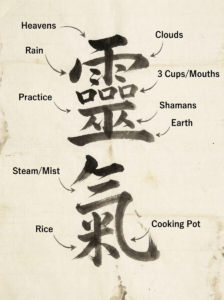
The original Chinese tradition describes each person as being composed of ten soul-aspects: three hun (魂) and seven po (魄). The hun are the lighter, more ethereal souls. They are oriented toward Heaven, consciousness and spiritual awareness. The po are the denser, more Earth-bound aspects. They are tied to the physical body, instinct and survival. Think of the hun as the parts of you that dream, reflect, and intuit; the po as the parts that keep you breathing, grounded, and embodied.
Looking at the actual brushstrokes in the kanji of Rei: Heaven is the line at the top, Earth is at the bottom, and the three cups or mouths in the middle represent humanity. This is san mitsu (the Three Diamonds). The hun soul-qualities live in the Heaven Diamond; the po soul-qualities live in the Earth Diamond; and the Heart is where they breathe together as one. The balance, of Heaven and Earth, body and spirit, held together by breath, is what the system of Reiki cultivates.
So when we say Rei in Reiki, we are not just saying “spiritual” in the vague way that word gets used in English. It speaks of the spiritual force that animates the Universe itself, not only living beings, but the felt sense of the sacred aliveness, the numinous, that moves through nature, through sacred places, through everything that flows. When we practise the system of Reiki, we are not generating this force. We are embodying it.
What Happens When We Die… and When We Don’t
According to Daoist texts, at death the hun and po separate. The three lighter hun souls return toward Heaven, eventually to be reborn. The seven denser po remain with the body, slowly dissolving back into the Earth. The “team” disperses.
But there is an exception.
If a person becomes enlightened during their lifetime, if they have purified and refined themselves sufficiently, and lived in that state of unified, luminous awareness then something different happens. Their soul-team does not scatter. The Ling (the Rei) stays intact; coherent. And this unified soul continues to exist at a different level of reality, present to guide those who are still walking the path.
This is, in the Daoist understanding, what an enlightened ancestor actually is. Not simply someone who lived a good life and is now resting comfortably in the afterlife. But a coherent, unified soul-being, actively present as a source of wisdom, healing, and guidance for those still in the human realm.
Giving and Receiving Reiju
Now consider what this means for Reiju.
Reiju (霊授) is often translated simply as “spiritual blessing”. But breaking down the kanji gives us something more specific.
Rei (霊) is that spiritual intelligence we have been discussing.
Ju (授) means to give or to receive something of profound value. Not something you can buy, but something conferred by the divine, by nature.
The idea proposed in the book of Emperor Meiji’s poetry is this: when we receive Reiju, we are – in the Daoist sense – receiving Rei. We are calling upon all the enlightened ancestors, the sum total of every human being who has walked this path and achieved that state, and we sit with their balance and wisdom. Reminding us of what we already are. Wholeness.
For many, this reframes Reiju.
It is not a transaction between two people in a room. It is a moment of remembering those who have achieved the unified soul. The teacher, in performing Reiju, brings about this open space through ritual and intent. The student, too, sits within it and momentarily touches that vast accumulation of human wisdom and lightness of being. This is why Reiju is not one-directional: both teacher and student receive, because what flows belongs to neither person and, yet, has always belonged to both.
“Why Don’t You Try Dying Once?”
Which brings us to Mikao Usui.
The man, according to Hiroshi Doi, from whom this entire system of Usui Reiki Ryoho practice descends, spent years seeking what the Japanese call anshin ritsumei; a state that gestures toward something like complete equanimity, the lived recognition of one’s true purpose. Not peace as the absence of difficulty, but unperturbed peace. The soul settled into its own nature.
Hiroshi Doi describes Mikao Usui’s quest this way: he practised Zazen meditation at a Zen temple in Kyoto, with the explicit aspiration to attain true awareness and to live in that consciousness. After three years, he was no closer to the breakthrough he sought. Frustrated, he went to his teacher and asked: how must I train to achieve this state?
The response was: “Die one time.”
This is a Zen instruction, not a suggestion for physical harm. The idea of “dying once” in Zen refers to the experience of ego-death: the falling away of the constructed, defended, habitual self, so that what remains is open, undivided awareness.
A Moment on the Mountain
Taking this instruction, Mikao Usui sat in meditation for twenty-one days on Mount Kurama. What happened at the end of those twenty-one days is described on the Usui memorial stone in Kyoto as feeling a great Reiki above his head. He came away from that experience with the awareness of an ability to heal and to share this gift with others.
Mikao Usui spent years seeking anshin ritsumei and what arose from time on the mountain was not simply inner peace but a gift turned outward. What the Zen teacher’s instruction had pointed toward became, in that moment, not private illumination but purpose: something to be shared, taught, and passed on. A satori – a glimpse of what the soul-team, unified, actually feels like. Not necessarily a permanent arrival, but enough. Enough to know it was real, and enough to want to offer that possibility to others.
The Many-Layered Self
During recent forum discussions at Shinpiden+, the observation was made that we appear to be comprised of many different parts, many different voices, even different personalities. We contain multitudes.
The Daoist three hun and seven po are not a literal anatomical description. They are a map of the complexity of human consciousness. We acknowledge the many aspects of self that coexist within us, sometimes in harmony, sometimes in conflict, often depending upon who and what we interact with. What Mikao Usui experienced on Mount Kurama can be understood as a moment in which these soul-aspects aligned. The ten-part team became, if only for a moment, one. What shone through was Rei, the soul in its fullness, no longer fragmented, no longer at war with itself. This is what Mikao Usui also wished for us.
Every time we sit in Reiju, we are joining a vast, continuous thread of human beings who have sat in this same quality of openness. The feeling of a great Reiki above Mikao Usui’s head on the mountain did not come from nowhere. And neither does what we receive in our practice. We, however, do not need to die one time.
Mikao Usui created this practice for everyone, to support us all in finding the harmony and wellbeing he knew existed. That gift is shared through this practice. What he found on that mountain, he brought back for all of us; the possibility of the soul-team, finally at peace with itself.
Sit. Breathe. Begin.
Want to find out more about the system of Reiki from a Japanese perpective?
Come and join my online teachings of Shinpiden+!
* Songs from Hearts Sincere: Inspirational Poetry of Emperor Meiji
by Frank A. Lombard & Brian Wilkes