

Research: Reiki Treatments vs Rest for Cancer Fatigue
July 29, 2026
We built a Reiki Dōjō
August 11, 2026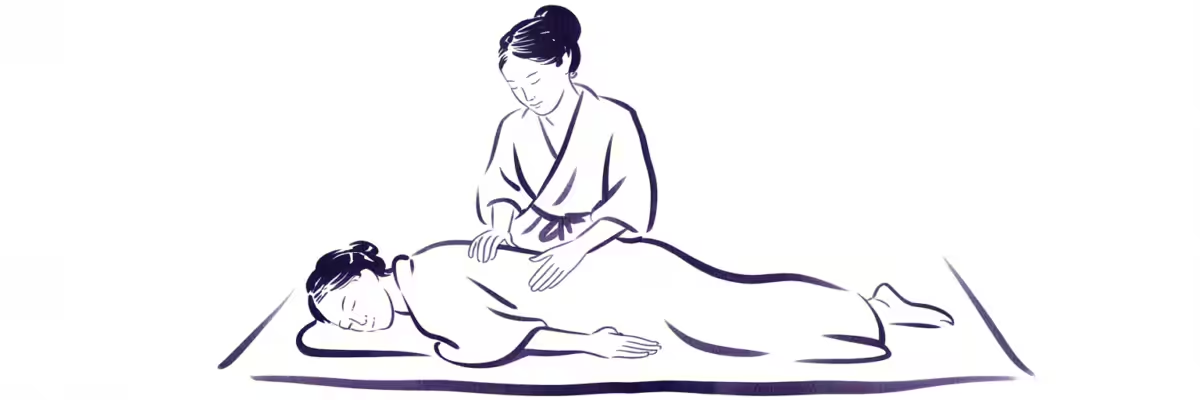
A groundbreaking 2024 study showed that massage triggers oxytocin release from the hypothalamus, which acts directly on the spinal cord through a single, evolutionarily conserved circuit — simultaneously reducing pain and enhancing the reward of gentle touch. This is the first study to identify the precise neurological mechanism behind why touch-based therapies work. The finding was confirmed in both mice and humans.
In Usui Reiki Ryoho, practitioners regularly report that recipients experience both pain relief and a quality of deep pleasure or peace during sessions. This research reveals the neurological mechanism behind that experience: gentle, conscious touch triggers an oxytocin cascade that works at the level of the spinal cord — before the signal even reaches the brain. The system of Reiki is operating on ancient biology.
Hawayo Takata practiced a specific technique at the end of her treatment called the Foundation Treatment or nerve stroke where she placed her “thumb and forefinger on the left side of the spinal column and the three fingers and palm flat on the right side of the spinal column. With a downward stoke, 10 to 15 strokes from the shoulders to the end of the spinal cord.”
If you would like to learn more about Reiki Treatments, how they work and what they can do for you, come and join my Shinpiden+ on-demand course.

2 Comments
Hi Bronwen,
Hope all is well and congratulations on your new and continuing projects.
I’m Jaimee, Reiki practitioner based in Melbourne and also have studied a Bachelor of Biomedical Engineering.
I’m excited to get back into reading the research of Reiki, it seems there has been many articles published in the last 6 years since I last took a deep dive.
Anyhow – I was wondering what if any difference there is between reiki treatments and prayer.
While there is a difference between ‘sham reiki’ reiki in intrigued what are the common elements to healing or medicine miracles.
I’m also currently on the ARC committee.
Look forward to meeting in person one day.
Hi Jaimee,
I love ARC! As you probably know I was on the committee many moons ago.
Thanks for the question.
Prayer and Reiki practices – such an interesting subject. Here are some thoughts…
Historically, prayer-like language does turn up in Japanese Reiki, although I think it is dependent upon the kind of prayer you might have in mind. In Japan, there’s a distinction between prayer as petition (asking for favours, sometimes called okage religion, the religion of blessings received: let me be well, let me prosper) and prayer as reverent attention (where the point is to become someone closer to the divine rather than to obtain anything). The system of Reiki I feel sits with the second. The practitioner is holding an intention, not lodging a request with a God who might intervene. Where contemplative prayer and Reiki practice genuinely converge is ritual and relationship. Both put a person in a defined setting, for a defined time, with someone whose whole attention is on their wellbeing, inside a practice that both parties recognise as meaningful. As far as I’m aware, though, nobody has actually studied that comparison. There is research into Reiki vs placebo though (see below).
As to Reiki practice and science. Historically, in the Reiki Ryōhō Hikkei, Usui writes that he didn’t receive the method from anyone and didn’t study to acquire it, that a time will come when it agrees with science but at the present level of science its source can’t be explained, and that while it might be called a psychic method of treatment, for the most part it can also be called a material one.
I would love to hear what sort of research you would be interested in undertaking.
x B
Here’s some research that you might enjoy:
https://link.springer.com/article/10.1186/s13643-025-02811-5
https://www.academia.edu/34781195/Effect_of_Hands_on_Reiki_on_Perceived_Stress_and_Subjective_Wellbeing_among_software_professionals_in_Bangalore
https://www.frontiersin.org/journals/psychology/articles/10.3389/fpsyg.2022.897312/pdf