
How is Reiki practised differently in Japan versus the West?
October 13, 2026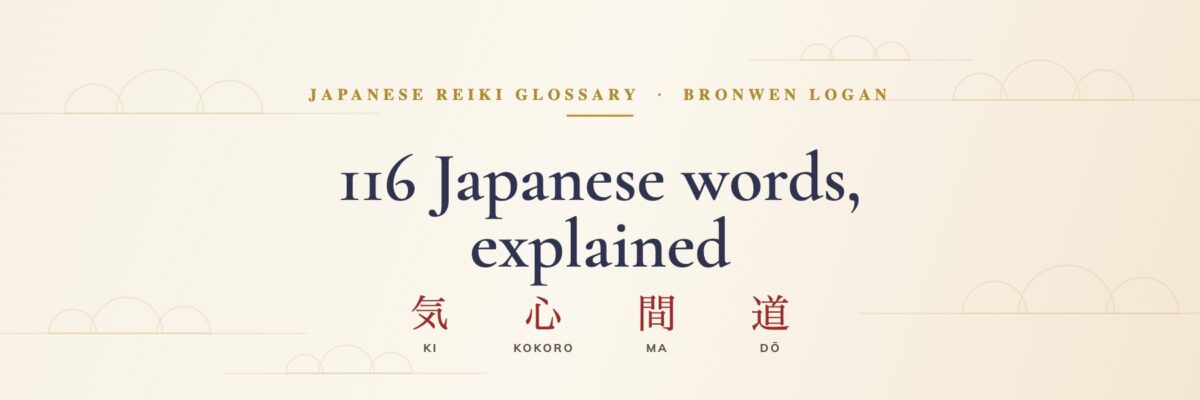
The system of Reiki comes from Japan, and so do its words. Reiju, gasshō, hara, kokoro: each one carries more than a one-word English translation can hold. Translate kokoro as “heart” and you lose the mind. Translate it as “mind” and you lose the heart.
For my Shinpiden+ students I put together a glossary of the Japanese terms we use, so they would have one place to look up a word, see its kanji and read a short explanation. I have now opened that glossary to everyone.
Open the Japanese Reiki Glossary
What is in the glossary
There are 116 terms, listed A to Z. Each has its kanji and a short explanation. You will find:
- The precepts, phrase by phrase, from kyō dake wa (“for today only”) to hito ni shinsetsu ni.
- The meditations and techniques, such as Jōshin Kokyū Hō, Hatsurei Hō and Byōsen Reikan Hō, with the meaning of each part of the name.
- The words underneath the practice: ki, hara, tanden, kotodama, funi.
- The history: Usui Reiki Ryōhō Gakkai, Kurama-yama, the Hikkei and the Shiori.
- The traditions the system grew out of, with terms from Mikkyō, Shintō and Shugendō.
There is a search box at the top. Type “breath” and you will see every entry that mentions it. Where I have written more about a term, the entry links to that post, and those posts now link back to the glossary.
Three words to start with
Kokoro 心
The Japanese concept of ‘heart-mind,’ representing the unified seat of emotions, spirit, and thought.
Ma 間
The Japanese concept of negative space, pause, or interval, the meaningful emptiness between things, reflecting the understanding that stillness, silence, and space are as alive and purposeful as form and sound.
Kyō dake wa 今日丈けは
The opening phrase of the precepts, ‘for today only’, grounding practice firmly in present-moment awareness rather than past regret or future anxiety.
A note on the symbols
The four mantras and symbols are listed by their initials only: CKR, SHK, HSZSN and DKM. Many teachers and lineages keep the names within the teachings, and I want the glossary to be a place every practitioner feels comfortable using.
Why the words matter
A glossary will not give you the practice. Only practising does that. But the words are a way in. When you know that Reiju means a spiritual blessing, or that Hatsurei Hō means a method for generating spirit, you begin to see what each practice is for.
If there is a word you think should be there, let me know and I will add it.
The glossary began inside Shinpiden+, my online course for anyone who has completed Reiki III, where we work with these teachings in depth.
Open the Japanese Reiki Glossary