Reiki Waka: Humility & Reflecting the Mountain
May 11, 2026
Research: Reiki Training for Caregivers of Hospitalised Children
May 21, 2026
Walk into almost any Reiki class anywhere in the world, and you’ll be told that Chujiro Hayashi, student of Mikao Usui, was a doctor, or more specifically, a surgeon. Wikipedia says it. Most lineage charts say it. I used to say it. And until recently, very few of us thought to question it. I mean, come on! Surely if Mikao Usui wasn’t a doctor then Chujiro Hayashi had to be? We can’t have been fooled twice?!
Thanks to an online post by independent researcher and Gakkai member Mamoru Wakatake (a pseudonym), that assumption is finally being examined. The primary sources, including Japanese government records, Imperial Japanese Navy paperwork, Hayashi’s own manuals, and the certificate he signed for Hawayo Takata in 1938, tell an interesting story.
The conclusions in this article are based on the documents currently available. If primary sources surface that change the picture, the picture should change with them.
Let’s see what they actually say.
The Certificate That Started the Question
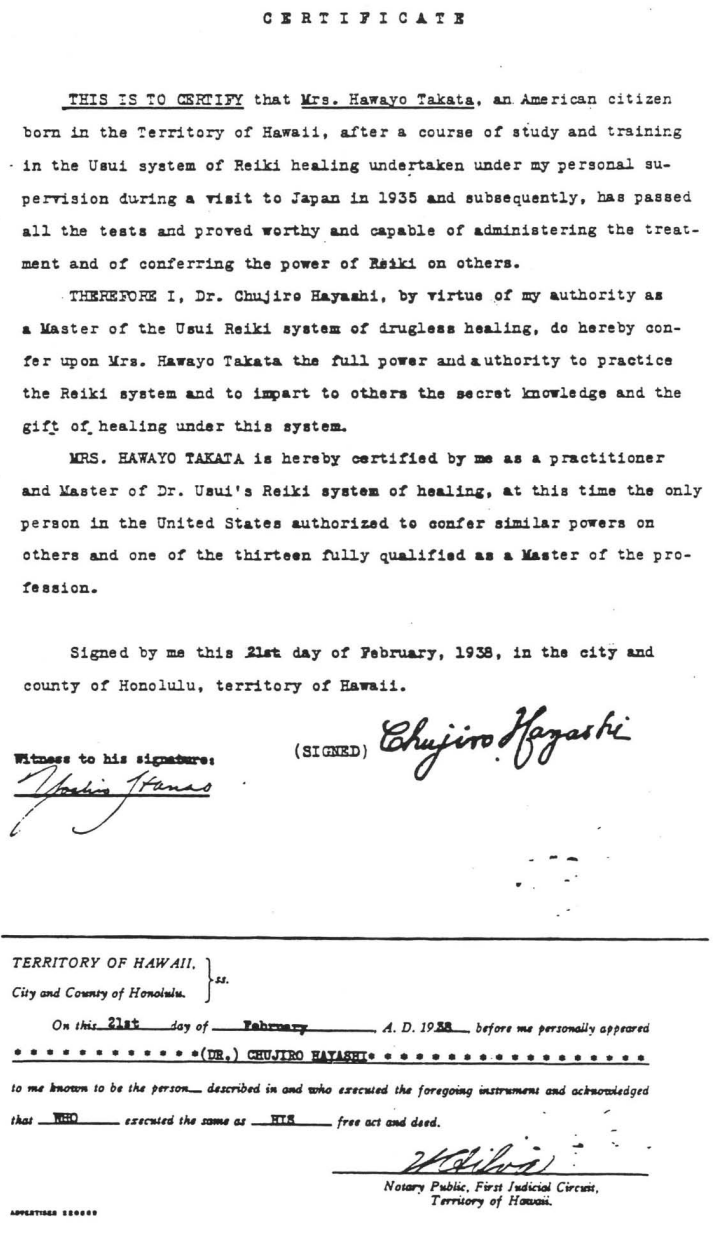
One of the strongest pieces of evidence that Hayashi used the title “Dr.” is the certificate he signed for Hawayo Takata on 21 February 1938 in Honolulu. The body of the certificate reads, in apparent first-person voice:
“THEREFORE I, Dr. Chujiro Hayashi, by virtue of my authority as a Master of the Usui Reiki system of drugless healing…”
He signed below it. The notary public’s acknowledgement records that
“(DR.) CHUJIRO HAYASHI”
personally appeared and acknowledged the document as his free act and deed. So that should settle it, right?
Except, read the next paragraph of the same certificate:
“MRS. HAWAYO TAKATA is hereby certified by me as a practitioner and Master of Dr. Usui’s Reiki system of healing…”
On the same certificate, Hayashi calls Usui “Dr.” too.
And Usui was definitely not a medical doctor.
So before we get to Usui’s CV, there’s a more basic question to ask about this document that, as far as I can tell, nobody is asking.
Did Hayashi Write Hawayo Takata’s Certificate?
Here’s something to think about: Of every document associated with Hayashi’s five months in Hawaii: his newspaper articles, advertisements, seminar promotions, public lectures, branch records, his radio farewell broadcast, the farewell party speeches – the Takata certificate is essentially the only English-language document. Everything else is in Japanese.
Thanks to Masaki Nishina’s careful work with the Hawaii Hochi archives, we now have an extraordinarily detailed picture of how Hayashi actually operated in Hawaii.
- The newspaper covering his every movement was a Japanese-language paper.
- His advertisements ran in Japanese.
- His seminars were taught in Japanese and even when “Caucasians, Hawaiians, and Chinese who don’t understand Japanese at all” attended (his own words from the broadcast), they learned through translation.
- His public lectures, including the one to over 200 people at the Buddhist Youth Hall, were in Japanese.
- His farewell broadcast on KGMB was in Japanese.
- The 200-strong farewell party had a Japanese MC, Japanese student representatives, and Japanese speakers.
- The Hawaii branch’s officers (Aoyama, Tamayose, Ueda, Morohashi) were all Japanese-speakers.
- Even the venues (the Buddhist Youth Hall 仏教青年会館, Natsunoya, Shun-chou-rou) were Japanese-Hawaiian community institutions.
In other words, Hayashi’s entire Hawaii visit took place inside the Japanese-speaking community of Honolulu. This can be seen as a parallel cultural and linguistic world that had grown up around the large Japanese immigrant population since 1885. He was not operating in English. He was not teaching in English. He was not socialising in English.
And then, on his second-to-last day in Hawaii, he signed one English-language document.
Read in that Context, the Certificate’s own English Gives it Away
“By virtue of my authority”, “do hereby confer“, “the full power and authority“, “free act and deed“. This is American legal-template English. The format itself is a formal certificate followed by a notary’s acknowledgement block and is an American legal artefact. Even a fluent non-native English speaker working alone wouldn’t naturally produce this, and there is no evidence Hayashi was fluent. His signature in Roman script shows he could write his own name in English. His own treatment manual is entirely in Japanese. He has no other English-language documents to his name that I am aware of.
The simplest reading is that the certificate was drafted in Hawaii, in English, by Takata or someone working with her, and presented to Hayashi for his signature. The witness on the document is Yoshino Hanao, another Japanese name from Takata’s Hawaii community. The notary was a US official in Honolulu. Everything about this document was assembled in Takata’s world, not Hayashi’s.
Takata Almost Certainly Needed this Document
In 1930s Hawaii (then a US Territory), drugless healers, naturopaths and similar non-medical practitioners operated in a regulated space. To set up a Reiki practice and to advertise herself as authorised to teach others Takata needed paperwork demonstrating that her training had been completed and that she could practice on and teach others. Self-created certificates don’t get notarised. By notarising this document, Takata could legally rely on it, in front of US authorities, advertisers, and clients.
We don’t have to guess at this as Takata’s subsequent actions confirm it. Researcher Masaki Nishina has documented that her Honolulu directory listing in 1938 records her occupation as “massage” (a recognised regulated category for non-physician healers in Hawaii Territory at the time). And after Hayashi returned to Japan, Takata travelled to mainland America and attended a school called the “National College of Drugless Physicians”. She was, in other words, deliberately and methodically establishing herself within the formal US drugless-healing professional space, which was exactly the category named in the certificate’s own phrase, “Master of the Usui Reiki system of drugless healing“.
So the most plausible scenario is not that Hayashi sat down to write a self-aggrandising certificate. It’s that Takata needed credentialing paperwork to launch her business in Hawaii, drafted (or had drafted) the standard kind of certificate American drugless healers would use, included the title “Dr.” as appropriate elevated framing for that audience, and got Hayashi to sign it before he sailed home. Hayashi assented by signature. He almost certainly did not author the words.
This is strongly reinforced by the fact that the same document calls Usui “Dr.” Whoever drafted it was using “Dr.” as an honorific for the founder of a healing system, not as a claim of medical credentialing. Hayashi knew Usui had no medical degree. By signing a document where “Dr. Usui” appears, he was simply using the title in the same elastic, honorific sense (the English-language equivalent of Sensei) that offers respect.
Was Usui a Doctor?
The answer is unambiguous: no. Usui’s own handwritten CV, recently uncovered in Taiwan’s national archives by researcher Min Wang, walks through his education and career step by step (you can read the full breakdown here on my blog). It includes classical Chinese, psychology, law school, missionary education work, time in San Francisco, and consultancy work. There is no medical school. No medical licence. No doctorate of any kind. And critically, Usui’s own memorial stone calls him “Sensei”, never “Dr. Usui”. When Hayashi signed a document calling both himself and Usui “Dr.” in 1938, he was assenting to an English honorific, not a credential.
What About Hayashi Himself?
Based on the primary sources currently available, the picture is this:
1934 – Taishū Jinjiroku (a major Tokyo directory): Hayashi’s entry lists him with the Hayashi Reiki Research Society (林靈氣研究會). No medical title appears.
1937 and 1938 – same directory: the descriptors change. The rank 海軍醫大佐 (“Naval Medical Captain”) now appears, along with the honorifics “Senior Fifth Rank, Third Order of Merit” and the descriptor “Doctor.” There are two problems with this. First, 海軍醫大佐 is not a real Imperial Japanese Navy rank. The correct designation for a naval medical captain was 海軍軍醫大佐, with an extra 軍 character before 醫 (so: “Navy / Military-Physician / Captain”). The directory’s version drops that 軍, producing a rank that does not appear in any official naval register. Second, and there is no record in the documents currently available of Hayashi attending medical school or sitting any medical exam between 1934 and 1937.
And crucially, the Taishū Jinjiroku was based on self-reported data. The medical descriptors came from Hayashi himself (or his agent), not from a third party making an error. The question, then, is why he chose to describe himself this way in 1937 and 1938 but not in 1934.
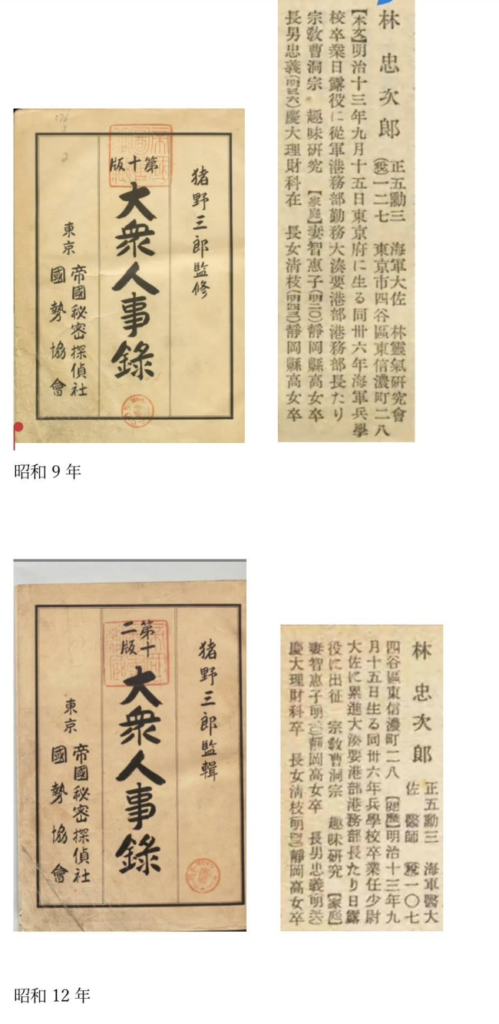
Entries for Chujiro Hayashi in the Taishū Jinjiroku (Tokyo directory). The earlier listing records his rank as Navy Captain (海軍大佐). The later listing introduces the (non-existent) rank ‘Naval Medical Captain’ (海軍醫大佐) along with the descriptor ‘Doctor’ , neither of which matches any actual Imperial Japanese Navy rank.
Source: Mamoru Wakatake, via the National Diet Library digital archives.
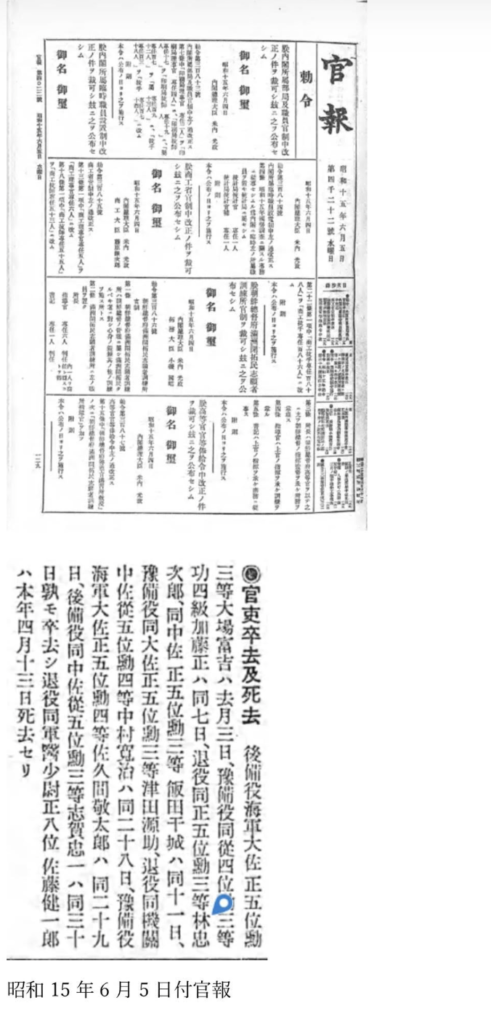
1940 – the Kanpō (Japan’s official government gazette): Hayashi’s death notice records him as “Retired Navy Captain (海軍大佐), Senior Fifth Rank, Order of the Third Class.” No medical title. The same notice uses the proper medical-officer designation (軍醫少尉, “Naval Medical Sub-Lieutenant”) for a different deceased officer in the same paragraph. The Japanese government tracked the distinction. They simply did not apply it to Hayashi.
1937 – Hayashi’s own boarding record on entering Hawaii: This one is important. When Hayashi sailed from Yokohama on the Chichibu Maru in September 1937, his entry document recorded his occupation in his own self-declared terms as “Master of Hayashi Reiki Kenkyu”, with a handwritten addition: “Spiritual Healer.” Not “doctor.” Not “naval physician.” Not “naval surgeon.” This is direct primary evidence of how Hayashi (or his agent) declared his own occupation when entering US territory at the very moment under discussion and was six months before Takata’s certificate was signed. (You sometimes see online claims that Hayashi’s travel records list him as a “naval surgeon.” That claim does not match the actual document.)
Early 1910s — independent corroboration: Japanese Reiki master Masaki Nishina, a Jikiden Reiki dai-shihan in Hayashi’s direct lineage, has noted that Hayashi appears in Imperial Japanese Navy records of this period as a line officer (not a medical officer). The otakupapa.net article on Hayashi reproduces a Naval Gazetteer dated 1 December 1921 listing Hayashi (then a Lieutenant Colonel), and notes that medical officers in the IJN were given the distinct designation “Naval Physician [rank]” (海軍軍醫…) rather than “Naval [rank].” This further confirms that throughout his naval career Hayashi was tracked as a line officer.
A telling concession from inside the lineage. Masaki Nishina is a senior Jikiden Reiki teacher in Hayashi’s direct lineage. After examining the Hawaii Hochi articles that variously call Hayashi a “former naval doctor and captain” and (in another article) a “retired army doctor and captain” – which he certainly never was – Nishina writes:
“Master Hayashi is introduced as a Naval doctor in this article, but there is no clear evidence found to this day that shows he was a naval doctor. The only clue is the official pre-war tax record showing that he paid tax as a ‘doctor’.”
These tax records have not been made publicly available. The Hawaii Hochi articles, Nishina notes elsewhere, are riddled with errors in names and titles and cannot be relied on as primary evidence.
The Structural Argument
Hayashi graduated from the 30th class of the Imperial Japanese Naval Academy at Etajima in December 1902. The Naval Academy trained line officers (兵科士官) – combat commanders. Naval medical officers came from a completely separate track: civilian medical school first, medical licence, then training at the Naval Medical College (海軍軍醫學校), then commissioning into the medical corps. Based on the Imperial Japanese Navy regulations of the period, there was no mechanism to convert a line officer into a medical officer mid-career.
Here is Hayashi’s recorded career:
Naval Academy → ensign → Russo-Japanese War → promotion through line ranks to Captain → Director of Port Affairs at Ōminato → retirement
This is a regular line-officer trajectory. There is no medical school in there. No medical college. No licence.
But the Hayashi Manual Looks Like a Medical Document
Hayashi’s treatment guide does read like a medical document. It lists diseases by clinical name (gastric ulcer, pulmonary tuberculosis, peritonitis, Graves’ disease, pyelitis, cerebrospinal meningitis), notes prognosis, and assigns specific hand positions to each. It’s no wonder so many Reiki students have read this and concluded that the man who wrote it must have been a doctor.
But there are two separate questions here: who actually wrote it, and whether medical content requires a medical credential.
Thanks to clarification from Mamoru Wakatake, we can now place this document more accurately. The 靈氣療法必携 (Reiki Ryōhō Hikkei, “Reiki Ryōhō Manual”) is a three-part compilation: the 公開伝授説明 (Kōkai Denju Setsumei, “Explanation of the Public Teaching”), which contains the Q&A; the 治療指針 (Chiryō Shishin, “Treatment Guidelines”), which is the disease index that reads so medically; and the 御製 (Gyosei), the Meiji Emperor’s poems.
And here is the key point: the Chiryō Shishin was not Hayashi’s original creation. Long before Hayashi left to become independent, the Usui Reiki Ryōhō Gakkai already had its own treatment guidelines, then called 治療大意 (Chiryō Taii, “Outline of Treatment”). When Hayashi later established his own organisation, he wrote the Hayashi Reiki treatment guidelines based on that pre-existing Gakkai foundation. The clinical vocabulary, the structure, the disease-by-disease format, none of it began with Hayashi. He adapted the material from the Gakkai to his own needs.
The content still tells us he had an excellent working command of early-twentieth-century clinical vocabulary. There are several plausible non-physician sources for that:
- The Gakkai template he was working from. As above, the framework was inherited. The decision to list diseases by clinical name was already there.
- Fifteen-plus years of running a clinic. Hayashi treated Reiki clients daily over many years. Medical vocabulary is learnable, especially by someone immersed in clinical practice for that long, surrounded by physicians and patients describing their diagnoses in clinical terms.
- Naval training. Imperial Japanese Navy line officers received basic first aid and shipboard health-management training and managed crew health on extended voyages as part of their command. Hayashi also served in the Russo-Japanese War, where any officer would have encountered military medicine in practice. Exposure, not physician training, but a foundation.
- Self-study. Educated Japanese men of this era often read widely, including in medicine. Usui’s own memorial stone notes that Usui (also not a doctor) read medical texts. The same was likely true of Hayashi.
- Consultation with actual doctors. The Gakkai’s Q&A names physicians who supported the method. Hayashi clearly moved in circles where medical knowledge was being shared.
And critically, the Chiryō Shishin itself contains no claim to medical credentials. The title page identifies the Hayashi Reiki Research Society. Nowhere in the manual does Hayashi call himself 醫師 (physician). The clinical vocabulary is in the content; it does not assert that he was running a medical practice of any kind.
What Hayashi’s Own Teaching Says About Medicine
Look at what’s actually written in the Gakkai’s Reiki Ryōhō Hikkei, specifically in the Kōkai Denju Setsumei (Explanation of the Public Teaching) section:
Q. Do I need to have knowledge of medicine? A. My method is beyond a modern science so you do not need knowledge of medicine.
Q. Does Usui Reiki Ryōhō use any medicine and are there any side effects? A. Never uses medical equipment.
Q. What is the government’s reaction? …So my Usui Reiki Ryōhō does not violate the Medical Practitioners Law (医師法)…
That last answer is the key. The Gakkai’s official position to the Japanese government was not “we are doctors practising medicine”. It was the precise opposite: “we are not practising medicine, and the Medical Practitioners Law therefore does not apply to us”. That’s a deliberate, careful, legal positioning of Usui Reiki Ryōhō as a non-medical healing modality that is exempt from physician licensing precisely because it isn’t medicine.
This is also why the Hawaii certificate, even where it does call him “Dr.,” qualifies the title carefully: “Master of the Usui Reiki system of drugless healing“. In 1930s America, drugless was a recognised category used by chiropractors, naturopaths, magnetic healers and others who explicitly distinguished themselves from licensed physicians. The certificate’s very wording told its American audience: this is not Western medicine, this is something else.
Hayashi’s Own Voice on the Radio
There’s one more piece worth pausing on. On 20 February 1938, just one day before the Takata certificate was signed, Hayashi gave a farewell radio broadcast on Honolulu’s KGMB station. The full text was reprinted in the Hawaii Hochi, taken directly from the broadcast. It is the most authentic Hayashi-text we have from the entire Hawaii visit, because it is verbatim what he said in his own words.
He introduces himself at the opening of that broadcast simply as “Chujiro Hayashi of Usui Reiki Ryōhō.” Not “Dr.” Not “Naval Captain.” Not “naval physician.” No medical title at all. When Hayashi speaks for himself, in his own language and voice, to a Japanese-speaking audience he could expect to understand his framing perfectly, he uses no medical credential whatsoever. The “Dr.” that appears the next day on the English certificate to Takata simply isn’t a word Hayashi reaches for when introducing himself.
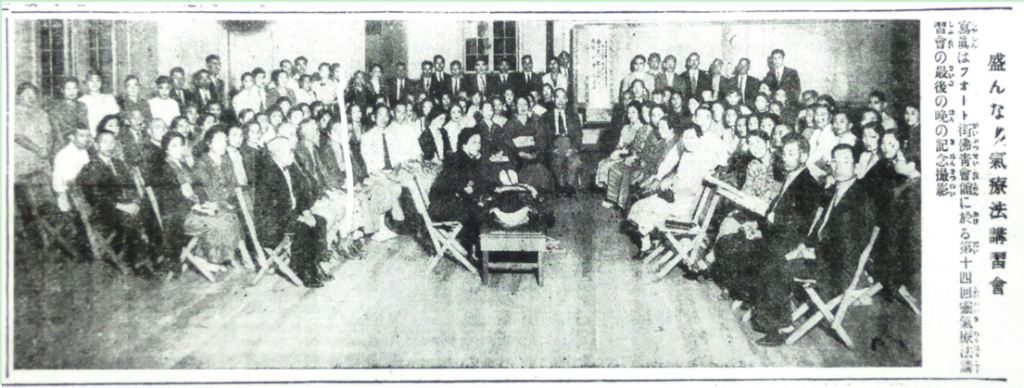
Source: Masaki Nishina, from the Hawaii Hoichi archives
So Was Hayashi a Doctor or Not
He was a Naval Captain. A line officer, not a medical officer. The Japanese state recognised him as such throughout his life and at his death. His own self-declared occupation on entering Hawaii in 1937 was “Master of Hayashi Reiki Kenkyu / Spiritual Healer.”
The title “Dr.” appears beside his name in some contexts: the 1937 and 1938 Japanese directories, and the 1938 Hawaii certificate. The certificate, on close reading, was almost certainly drafted by or for Takata to qualify her as a drugless healer in the US Territory of Hawaii. Hayashi signed it; he did not author it. In his own farewell broadcast the day before, speaking in his own language he used no medical title.
Where the title appears, it functions as an honorific. The proof is on the certificate itself, where the same word “Dr.” is applied to Usui, who indisputably had no medical training. In Japanese tradition, Sensei serves the same function: a respectful title for a teacher or master that doesn’t require any specific credential. When “Dr.” appears in English-language Reiki documents from this period, it is likely functioning as the English equivalent of Sensei.
His teachings make this explicit. Reiki Ryōhō, in Hayashi’s own materials and in the Gakkai’s Q&A, is positioned as something other than medicine: not better, not worse, just different. It does not require medical knowledge. It does not violate the Medical Practitioners Law. It uses no medical equipment. It is, using the certificate’s own phrase, drugless healing.
Why Would Hayashi Describe Himself This Way?
Wakatake offers a reading that fits the rest of the evidence. He writes:
“Perhaps it was because ‘Doctor’ was the only word that most accurately represented his ‘social role and actual situation’ at the time. The clinic at ’28 Higashi-Shinanomachi’ mentioned in the documents was very large, lining up many beds and treating seriously ill patients every day. In reality, he was already the ‘director of a hospital’ and was treated as a ‘great doctor’ by those around him.”
Wakatake also points out that the late 1930s in Japan was a period of tightening regulations on quasi-medical practice, and suggests Hayashi’s use of “Doctor” in a self-reported directory entry may have functioned as a defensive measure – protective rather than fraudulent.
That reading sits neatly alongside what we know about the 1938 Hawaii certificate, which performed the same function in a different regulatory environment: Takata, needing to establish her drugless-healing practice in the US Territory, drafted (or had drafted) a document that called Hayashi “Dr.” in part because the credentialing context required it.
When “Doctor” appears beside Hayashi’s name, it tends to appear in places where regulatory pressure made the word useful. In the documents where he is speaking purely for himself — his boarding record, his radio broadcast, his own manuals — it does not appear.
What This Means for Us
Based on the documents currently available, Hayashi was not a Western-style medical doctor. He did not graduate from the Naval Academy “as a medical doctor”. He was not a “naval physician” or a “naval surgeon”. Those were specific Imperial Japanese Navy ranks he never held. The Japanese government never recognised him as a medical officer at any point in his career.
But he ran a serious Reiki clinic. He was treated as a “great doctor” by his patients and his community. And in Hawaii in 1938, his student Takata, needing legal credentialling paperwork to launch her practice in the US Territory, drafted a certificate that called him “Dr.” in the elastic American sense of “drugless healer”, and got him to sign it before he sailed home.
None of this diminishes him. Hayashi was a retired Navy Captain who built his own healing clinic in 1930s Tokyo, used a disease index that reads like someone with medical knowledge, and who carried the practice of Reiki Ryōhō to Hawaii in a form that allowed it to spread around the world, all without ever holding a medical licence, as far as the primary sources currently available show.
Sources and Further Reading
- Mamoru Wakatake’s research on the 1934, 1937, and 1938 Taishū Jinjiroku entries; the 1940 Kanpō death notice (primary sources from the National Diet Library digital archives); and the history of the Reiki Ryōhō Hikkei and its relationship to the earlier Gakkai Chiryō Taii. His facebook page.
- Masaki Nishina’s research on the 1910 Imperial Japanese Navy training-ship manual, the 1921 Naval Gazetteer, Hayashi’s 1937 boarding records, the Hawaii Hochi coverage of his Hawaii visit, his KGMB farewell broadcast, and Takata’s Hawaii directory listings published in detail at Hayashi’s Activities in Hawaii, and discussed, at otakupapa.net. The Hawaii Hochi articles themselves were originally located by Justin B. Stein and Hirano Naoko.
- Min Wang, Umi Chien, and Yu Hsuan’s discovery of Usui’s handwritten 1904 CV in Taiwan’s national archives synthesised by Justin B. Stein and summarised on my blog at The Life of Mikao Usui: A Visual Guide to New Historical Discoveries.
- The 1938 Takata certificate, signed by Hayashi in Honolulu, witnessed by Yoshino Hanao, and notarised on 21 February 1938.
- Hayashi’s KGMB radio farewell broadcast of 20 February 1938, reprinted verbatim in the Hawaii Hochi, 22 February 1938.
- The Hayashi Chiryō Shishin (治療指針, Treatment Guidelines) and the Gakkai’s Reiki Ryōhō Hikkei (靈氣療法必携), a three-part compilation containing the Kōkai Denju Setsumei (Explanation of the Public Teaching, which includes the Q&A traditionally attributed to Usui), the Chiryō Shishin, and the Gyosei (Meiji Emperor’s poems). Note that the Gakkai’s treatment guide pre-dates Hayashi’s independence under the title Chiryō Taii (治療大意, Outline of Treatment); Hayashi adapted that earlier Gakkai material when establishing his own lineage.
If anyone reading this has access to other primary documents, the pre-war tax records noted in the lineage research, or Hawaii Territorial business and licensing records from 1938 onwards, I would genuinely welcome the opportunity to look at them.

4 Comments
So very interesting! I appreciate all the research, articles and information that bring new light to this question of whether Hayashi was truly a licensed medical doctor. Thank you so much!
Hey Brenda, I was surprised to find so much good, solid research (and hard work) available on this subject! Thanks for your support.
x B
When I was researching the history of Reiki and other topics to fill in the holes I came upon a lot of this material – that would have been in the early 2000’s. I was not surprised to find the ways in which Takata Sensei manipulated her paperwork. It tracks with what we know of her biography – working in the business side of the pineapple plantation gave her a great deal of business acumen which she doubled down on when she came out to California. What I find most interesting in the research that I did was learning that, prior to WW2, forms of healing using teate, like Reiki were not officially interfered with in Japan. During the American Occupation of Japan after WW2 our government made it illegal for teate healers to work with the single exception of disabled individuals, with priority given to WW2 vets. In this way, blind men could become massage therapists and operate under licenses without interference. I’ve also seen this covered in some historical manga that I’ve read – the massage work not the teate. I have a very deep fondness for Hayashi Sensei and while researching him I found more questions than answers, particularly when he returned from his trip to Hawaii, the Japanese military, and his seppuku. The research analyst that was grad school me is negotiating with my fondness and respect for Hayashi Sensei to give him his privacy but it’s a really intense conversation because I cannot deal with gaping holes in my data.
Hi Tree, thanks for your thoughts.
Interesting about practices after WWII.
I know in the book “Women in Reiki” that it says Chie Hayashi took over the Reiki practice from her husband (she said she was present when he slit his wrists with a surgical knife rather than what I think is presumed as seppuku). The book says he didn’t want to divulge “critical information” about Hawaii to the navy.
The Hayashi’s had 5000 members in the Hayashi Reiki Kenkyukai, so it was quite a large practice. But as her husband had been a war resistor Chie needed to be careful and officially closed the practice after his death. Chie quietly continued to teach however (there is a certificate signed by her from a student in 1943).
As you say, the system of Reiki was outlawed as an Eastern practice when Japan became occupied by America (which ended in 1952). The blind massage therapist detail is fascinating!
Unfortunately for Chie, she couldn’t find a successor for her teachings. Apparently Chie asked her niece Katsue (Chiyoko Yamaguchi’s sister) and Hawayo Takata who visited in 1954 to take over, but no one took this on and the Hayashi Reiki Kenkyukai faded out.
x B