
Reiki Research: The Science of Touch
February 10, 2026
Why Waka Poetry Remains Essential to Reiki Practice Today
February 22, 2026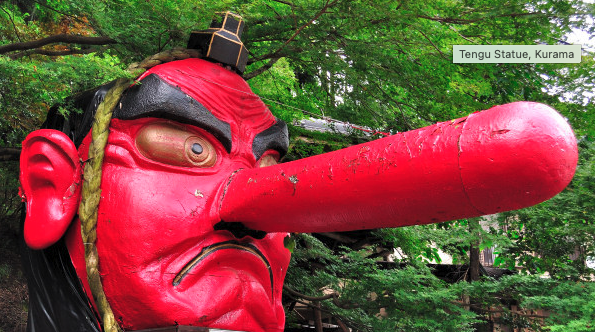
If you’ve ever visited Mt. Kurama, north of Kyoto, you’ll have encountered the red-faced Tengu statue at the Kurama Train Station. It’s pretty frightening with its long nose, fierce expression, and unmistakable presence of something other. This is Sōjōbō, the king of all Tengu or the Dai (great) Tengu. For many Western visitors, there is an immediate impulse to file the Tengu alongside angels, spirit guides, and the rest of the New Age beings “out there,” watching over us from some separate realm.
But that interpretation misses something fundamental about how Japanese philosophy works.
The philosopher Thomas P. Kasulis has spent decades articulating what he calls the “default settings” of Japanese thought. One of the most important is the emphasis on internal rather than external relations. In Western thinking, when we say two things are related, we tend to imagine them as separate entities connected by some third thing. The self here, the spirit world there, and ritual as the train line connecting them both.
Japanese philosophy defaults to a different model: related things overlap. Mind and body aren’t two things yoked together but a single bodymind. The knower and the known interpenetrate (what a great word!). In Kūkai’s Shingon Buddhism (1), everything in the universe, every rock, sound, person, isn’t made by the Cosmic Buddha, Dainichi Nyorai. It actually is Dainichi’s activity. Remember that Dainichi Nyorai is the deity represented by Dai kōmyō, 大光明, the system of Reiki’s 4th ‘symbol’ (of course, it’s just kanji) and its reading. And because, in Japanese philosophy, everything is an expression of this same whole; any single part, whether it be a chanted mantra, a mountain path, or a moment of deep practice, can open onto the entirety. The whole is already present in every part, the way your entire genetic blueprint lives in a single strand of hair.
This matters for Mt. Kurama, because the mountain has deep roots in exactly these traditions. The Tengu of Kurama belongs to Shugendō, the mountain ascetic practice that blends Buddhism, Shintō, and Taoism. The Yamabushi who trained there understood the mountain not as a backdrop for contacting something elsewhere, but as a living mandala. The kanji for Yamabushi, 山伏, means “one who lies down in the mountains” which is symbolic of becoming one with the environment, open to the flow of natural elements rather than fighting them.
It was on this very mountain that Mikao Usui, the founder of the system of Reiki, undertook a 21-day meditation retreat, likely a Shugendō practice called Mizudachi no Gyo. Many believe Usui was a lay Tendai Buddhist with connections to Yamabushi practice. His posthumous Buddhist name, engraved on his memorial stone, begins with the kanji 霊山, Rei (spiritual) and Zan (mountain), echoing both the system of Reiki and the mountain traditions that shaped him.
Usui’s story is not unlike the famous legend of the young boy, Ushiwakamaru, who trains with the Tengu king Sōjōbō on Mt. Kurama and emerges as one of Japan’s finest warriors, Minamoto no Yoshitsune. It’s tempting to read this through Western eyes: a supernatural being descends, hands over secret techniques, and the boy receives them like a student downloading a lesson. But in the Japanese philosophical tradition, learning doesn’t work that way.
Kasulis writes that the student doesn’t receive knowledge across a gap. Instead, the student models themselves after the master through shared practice until the insight becomes their own. Dōgen (2) expressed this simply: “student and master practice together.” So Ushiwakamaru doesn’t receive swordsmanship from the Tengu as a gift from outside. He goes into the mountain, immerses himself in its wildness, and through fierce bodymind practice the skill emerges from the overlap between boy, mountain, and Tengu. They are not three separate things. The Tengu is the mountain’s energy meeting the boy’s discipline, and the sword was never handed over – it was already there, waiting to be uncovered.
So when Japanese tradition places a Tengu at Mt. Kurama, it is not installing an angel at a celestial checkpoint. The Tengu isn’t a being that exists independently “out there,” waiting to be contacted through the right ritual or frequency of thought. It is an expression of the mountain itself, of the fierce and untamed energies that arise in deep practice, inseparable from the practitioner and the path.
This is what gets lost when we import Japanese spiritual imagery into a framework built on separation. We turn the Tengu into a spirit guide with a postal address in another dimension.
The Tengu at Mt. Kurama isn’t guarding the gate between you and something beyond you. It is what the mountain looks like when it meets your practice: fierce, vivid, and utterly inseparable from the path you’re already walking.
1. Kukai, a Japanese Buddhist monk, calligrapher, and poet founded the esoteric Shingon school of Buddhism (774-835).
2. Dōgen, a Japanese Zen Buddhist monk, writer, poet, philosopher, and founder of the Sōtō school of Zen in Japan (1200-1253).
The Tengu image is from https://muza-chan.net/japan/index.php/blog/japanese-stories-tengu-mount-kurama
Tengu is one of 116 Japanese terms explained in my Japanese Reiki Glossary.